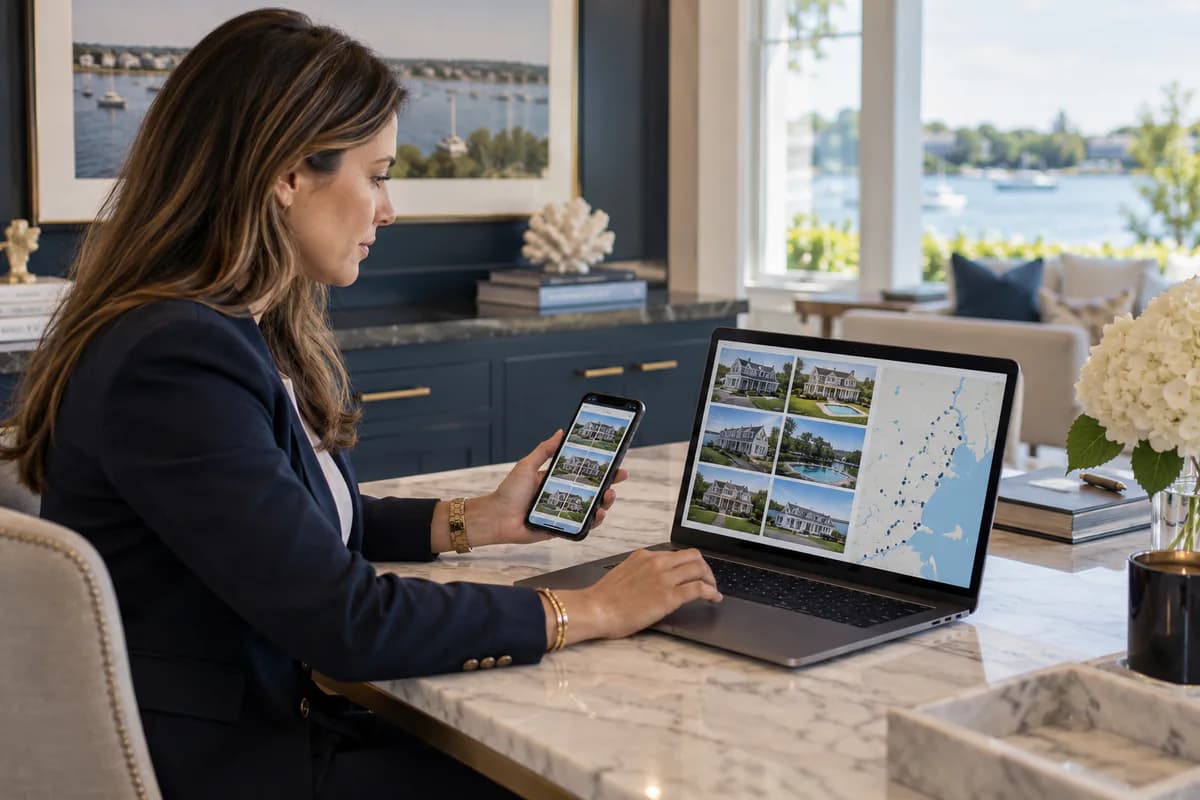
An agent working Greenwich and its neighbors often needs more than one MLS: the Greenwich Multiple Listing Service for Greenwich itself, SmartMLS for Stamford and the rest of Connecticut, and OneKey MLS for Rye, Port Chester and the rest of Westchester. A good IDX website pulls every feed you're entitled to, merges them into one search, removes duplicate listings and shows each MLS's required attribution.
That three-MLS setup is unusual, and it's why generic IDX plugins built for single-MLS markets often disappoint here. This guide explains which MLS covers what, how IDX approval and fees work, how to present one clean search across the state line, and which display rules you have to follow.
Why does Greenwich still run its own MLS?
The Greenwich Association of Realtors owns the Greenwich Multiple Listing Service, which it completed in 1954, while most other Connecticut towns have joined regional MLSs, according to Moffly Media's history of Greenwich real estate. The association's CEO, Stacey Loh, told Moffly: "We verify every listing and refresh them every five minutes."
The rest of the state consolidated. SmartMLS was created in 2017 when Connecticut MLS and the Greater Fairfield County CMLS merged; it went live that August with more than 17,000 members and, according to the National Association of Realtors' MLS consolidation case study, served an estimated 96% of Connecticut Realtors.
Across the border, OneKey MLS went live on March 24, 2020, combining the Hudson Gateway MLS and the Multiple Listing Service of Long Island. The Hudson Gateway Association of Realtors reported more than 44,000 subscribers at launch, covering Westchester, Putnam, Rockland, Orange, Sullivan, Nassau and Suffolk counties plus Manhattan, Queens, Brooklyn and the Bronx.
Which towns does each MLS cover?
For an agent based in or around Greenwich, the practical split looks like this:
| MLS | Where it matters for Greenwich-area agents | Run by |
|---|---|---|
| Greenwich MLS | Greenwich and its villages: Cos Cob, Old Greenwich, Riverside, Byram, Glenville | Greenwich Association of Realtors |
| SmartMLS | Stamford, Darien, New Canaan, Norwalk, Westport and the rest of Connecticut | SmartMLS, Inc. |
| OneKey MLS | Rye, Port Chester, Harrison, White Plains, Scarsdale and the rest of Westchester | OneKey MLS |
The boundaries aren't perfectly clean
Brokers can belong to more than one MLS, so the same property can appear in two feeds. IDX Broker's coverage list for the Greenwich MLS feed, for example, names Greenwich's villages alongside other Connecticut towns such as Stamford, Darien and New Canaan. Plan for overlap from the start rather than discovering it when a buyer sees the same house twice.
How does IDX approval work, and what does it cost?
IDX (Internet Data Exchange) is the set of MLS rules that lets participating brokers display each other's listings on their own websites. Access runs through the MLS: a broker participant signs the MLS's IDX agreement, an agent's site needs the supervising broker's authorization, and the website vendor must be approved to receive the feed. Expect paperwork for each MLS separately.
The data itself is inexpensive next to the website. IDX Broker's public coverage pages listed these data fees in September 2026, on top of the vendor's own subscription: Greenwich MLS, $30 a month plus a $35 connection fee; OneKey MLS, $23 a month plus $35; SmartMLS, $5 a month plus $35. The same pages list the Greenwich MLS and OneKey feeds as Web API feeds and the SmartMLS feed as RETS.
Three ways to put listings on your site
The quickest is a hosted IDX plugin or embedded search from an approved vendor: fast to launch, limited in design and search-engine value because the listing pages often live on the vendor's domain or render in a frame. The middle option uses a vendor's API to render listings inside your own site design, so search pages look and load like the rest of the site. The most flexible is a direct feed through the RESO Web API, replicated into your own database, which is what you need for custom search, cross-MLS deduplication and CRM automation. That last option is software development rather than web design, and it is scoped that way.
How do you show all three MLSs in one search?
The National Association of Realtors' IDX policy allows it: consumers may run a single property search across multiple IDX feeds, with results displayed from each MLS, as long as each listing still meets the rules of the MLS it came from. The work is in normalizing the data. Each MLS names towns, property types and statuses slightly differently; mapping them to the RESO Data Dictionary's standard field names gives you one filter set that behaves the same on both sides of the state line.
The payoff is a search experience that matches how buyers actually shop the corridor: one map from Old Greenwich to Rye, one saved search that sends new listings from either state, one set of alerts instead of three.
De-duplicating dual-listed properties
Match candidate duplicates on normalized street address and unit, then confirm with list price, beds, baths and listing brokerage. When two records match, display one of them according to a written rule, for example the record from the MLS where the listing broker is based, or the most recently updated one. Keep the displayed record intact from a single source instead of stitching photos from one feed onto details from another, so the attribution and disclaimer you show are accurate for everything on the page.
What IDX display rules do you have to follow?
Each MLS publishes its own IDX rules, and you must follow all of them for listings from that MLS. NAR's IDX policy sets the common floor:
Refresh at least every 12 hours
MLS downloads and the displays fed by them must be refreshed no less often than every 12 hours. Many vendors refresh far more often; IDX Broker lists hourly updates for its OneKey feed.
Identify your brokerage
Your IDX display must clearly show the name of the brokerage you operate under, in a readily visible color and typeface.
Respect seller opt-outs
Sellers can direct that their listing or address not be displayed online. Your import must honor those flags.
Leave confidential fields out
Showing instructions, security details and other confidential fields never belong on a public page.
Correct errors on request
You must correct or remove false data about a property when the listing broker tells you about it, so give them a way to reach you.
No compensation fields
Since the NAR practice changes took effect on August 17, 2024, offers of buyer-broker compensation are prohibited on MLSs. Don't build a commission display from MLS data.
Connecticut adds a date rule
Connecticut's 2024 advertising changes require broker and agent websites to show the last date property information was revised, unless it updates automatically from the MLS. A live IDX feed covers the listing pages; manually posted listings and market reports need a visible date. Our guide to Connecticut real estate website rules covers the full list, including New York's notices for agents who also work Westchester.
IDX vs VOW vs RESO Web API: what's the difference?
IDX
A license to display other brokers' active listings publicly on your site, under the MLS's IDX rules. This is what most agent websites need.
VOW (virtual office website)
A broader data set, which can include sold and off-market history, shown only to registered consumers who have a brokerage relationship with you. More data, more obligations.
RESO Web API
Not a license but a delivery standard: the RESTful API that the industry standards body RESO promotes in place of the older RETS protocol. Your IDX or VOW data may arrive through it.
What should a Greenwich agent's IDX website include?
Listings alone don't differentiate you; every competitor has the same inventory. What earns search traffic and trust is local content wrapped around the feed: neighborhood pages for Back Country, Belle Haven, Riverside, Old Greenwich and Byram written from real experience, market snapshots built from MLS data, and clear pages on how you work with buyers and sellers. Our real estate website service and local SEO checklist for Fairfield County go deeper on that side.
Behind the scenes, route every inquiry, saved search and showing request into your CRM so no lead sits in an inbox, and keep heavy listing photography fast with modern image formats and a CDN; our piece on Core Web Vitals for NY and CT business sites explains why speed affects both rankings and conversions. NixMar's business websites start at $2,500, with IDX scoped by feed and approach; direct-feed search and CRM builds are custom software, which starts at $10,000.
Frequently asked questions
Do I need Greenwich MLS IDX if I'm already in SmartMLS?
If you want buyers searching Greenwich on your website to see Greenwich inventory, add the Greenwich MLS feed. The Greenwich Association of Realtors runs its own MLS, so a SmartMLS feed alone may not give you the town's full inventory. You need to be a participant or authorized subscriber of each MLS whose feed you display.
Can one website show Connecticut and Westchester listings together?
Yes. The National Association of Realtors' IDX policy allows a single property search across multiple IDX feeds, provided each MLS has approved your display and each listing follows the rules of the MLS it came from. The technical work is normalizing fields across MLSs and removing duplicate listings.
How often do IDX listings have to refresh?
NAR's IDX policy requires MLS downloads and the displays fed by them to be refreshed at least every 12 hours. Many vendors refresh much more often, and the Greenwich Association of Realtors says it refreshes its own MLS listings every five minutes.
What does IDX cost for a Greenwich agent?
You pay the IDX vendor's subscription plus small MLS data fees. In September 2026, IDX Broker listed $30 a month for Greenwich MLS, $5 a month for SmartMLS and $23 a month for OneKey MLS, each with a $35 connection fee. The website itself is the larger cost; NixMar business websites start at $2,500.
One search, three MLSs, zero duplicates
The Greenwich market rewards agents whose sites reflect how buyers really shop: across town lines and state lines. Get authorized for each MLS you need, choose an IDX approach that keeps listing pages on your own domain, normalize and de-duplicate the feeds, and follow each MLS's display rules. The local content around the listings is what makes the site yours.