
Independent and specialty practices
Service pages for the conditions you treat, clear new-patient steps, accepted insurance and a fast path to scheduling.

NixMar Studio designs websites for independent, specialty and concierge medical practices in Greenwich, Fairfield County and across Connecticut.
Practice websites from $2,500

Practices that compete for patients under their own name: independent primary care, specialty groups, and concierge or membership-based physicians, from Greenwich and Stamford to Rye and White Plains.
Service pages for the conditions you treat, clear new-patient steps, accepted insurance and a fast path to scheduling.
A site that explains the model, the fee and the physician relationship clearly enough that the consultation call is about fit, not basics.
If your practice belongs to a health system, your web presence, scheduling and portal are usually managed by the system's own teams. We'd rather say that up front than sell you a site you can't use.
The strongest doctor and medical practice websites aren't the flashiest. They answer a worried patient's questions in plain language and make the next step obvious. If you've been collecting medical website examples, these are the patterns worth copying. For NixMar's own recent work, see our portfolio.

Accepting new patients, the insurance you take, then booking or a request form, all reachable from the homepage on a phone without hunting through menus.
Plain-language pages for the conditions you treat, reviewed by your physicians, that explain symptoms, options and when to call.
A one-minute welcome from each physician, filmed in your office, lets patients hear how you explain things before they book.
What to bring, how to complete forms, parking and directions, and how telehealth visits work, so the front desk answers fewer of the same calls.
A concierge practice sells a membership before it books a visit, so the website has to explain the fee, the panel and the enrollment steps. Our concierge medicine website guide covers each step, including the Medicare and HSA points to clear with counsel.

Prospects want the annual fee, what it includes (extended visits, same-day access, direct contact with the physician) and how it works alongside their insurance. A clear membership page answers the question most practices bury.
Concierge panels are capped, so the site takes consultation requests and waitlist sign-ups that route to your practice manager, with panel status editable in one place.
Membership agreements and payments run through your membership or billing platform. We link to it and keep the handoff clean rather than handling payment data on the marketing site.

Board certifications, training, hospital affiliations, languages spoken and a short note in the physician's own words. Each provider page carries Physician structured data and links to the services that doctor offers, so search engines connect the right doctor to the right practice.
Your EHR vendor already provides the patient portal and often telehealth. The website's job is to make them easy to find: a clear portal link in the header, first-time sign-in instructions and telehealth visit steps. Scheduling follows the same rule; we embed what your scheduling system supports instead of rebuilding it.
We keep protected health information off the marketing site. Intake forms run through a HIPAA-compliant vendor that signs a business associate agreement, the general contact form asks for no symptoms or conditions, and ad pixels stay off portal links, logged-in pages and forms. A June 2024 federal court decision narrowed HHS's tracking guidance for public pages, but tracking on authenticated pages and health-information forms is still covered, so we configure analytics conservatively with Google Consent Mode.
Practices that receive federal financial assistance from HHS, including Medicaid payments, must make their websites and apps meet WCAG 2.1 AA under HHS's 2024 Section 504 rule. The deadlines, extended by a year in May 2026, are May 11, 2027 for recipients with 15 or more employees and May 10, 2028 for smaller ones. We build every practice site to that standard and test it with a keyboard and screen reader. Our Section 504 deadline guide explains who is covered and lays out a 90-day remediation plan.
Most practices don't: the EHR's portal covers records, messaging and refills. If you're planning a patient app, remote-monitoring tool or provider workflow your EHR can't handle, that's a software project. See our healthcare app development work; mobile apps start at $8,000 and custom software at $10,000.
Practices usually compare three options. A website builder is the cheapest start. Healthcare marketing vendors offer template websites on a subscription. A custom website costs more up front, but it's built around your providers, your patient path and the portal and scheduling tools you already use, and you own it.
| Factor | Template or website builder | Healthcare website vendor | Custom website with NixMar |
|---|---|---|---|
| Upfront cost | Lowest: a monthly plan, plus staff time | Monthly subscription, often with a setup fee | Fixed quote, from $2,500 |
| Portal, scheduling and intake | Links you add yourself | Varies; some tie you to the vendor's own tools | Links and embeds from your EHR, scheduling and forms vendors |
| Patient privacy | Forms and ad pixels are up to you | Varies; ask what tracking runs on forms | No health details in contact forms; pixels kept off forms and portal links |
| Accessibility | Depends on the theme | Ask for an accessibility report | Built and tested to WCAG 2.1 AA |
| If you leave | Content is yours; the design usually stays | Check the contract: design and content may stay | You own the code, domain and content |
| Time to launch | Days, if staff build it | Usually quick, on an existing template | Typically 3 to 5 weeks |

We map your EHR, portal, scheduling and forms vendors and decide what the site links to versus what it hosts, then send a fixed-scope quote.
Page designs, provider bios and service copy reviewed with your physicians and practice manager.
We build the site, connect booking and portal links, and run an accessibility and third-party-script review.
Redirects, Search Console, Consent Mode analytics and a walkthrough so staff can update hours and providers.
Medical and concierge practice websites start at $2,500. A landing page for a single service or campaign starts at $699. EHR, scheduling and forms vendors bill separately. You get a fixed-scope quote before work begins; see every package on our pricing page.
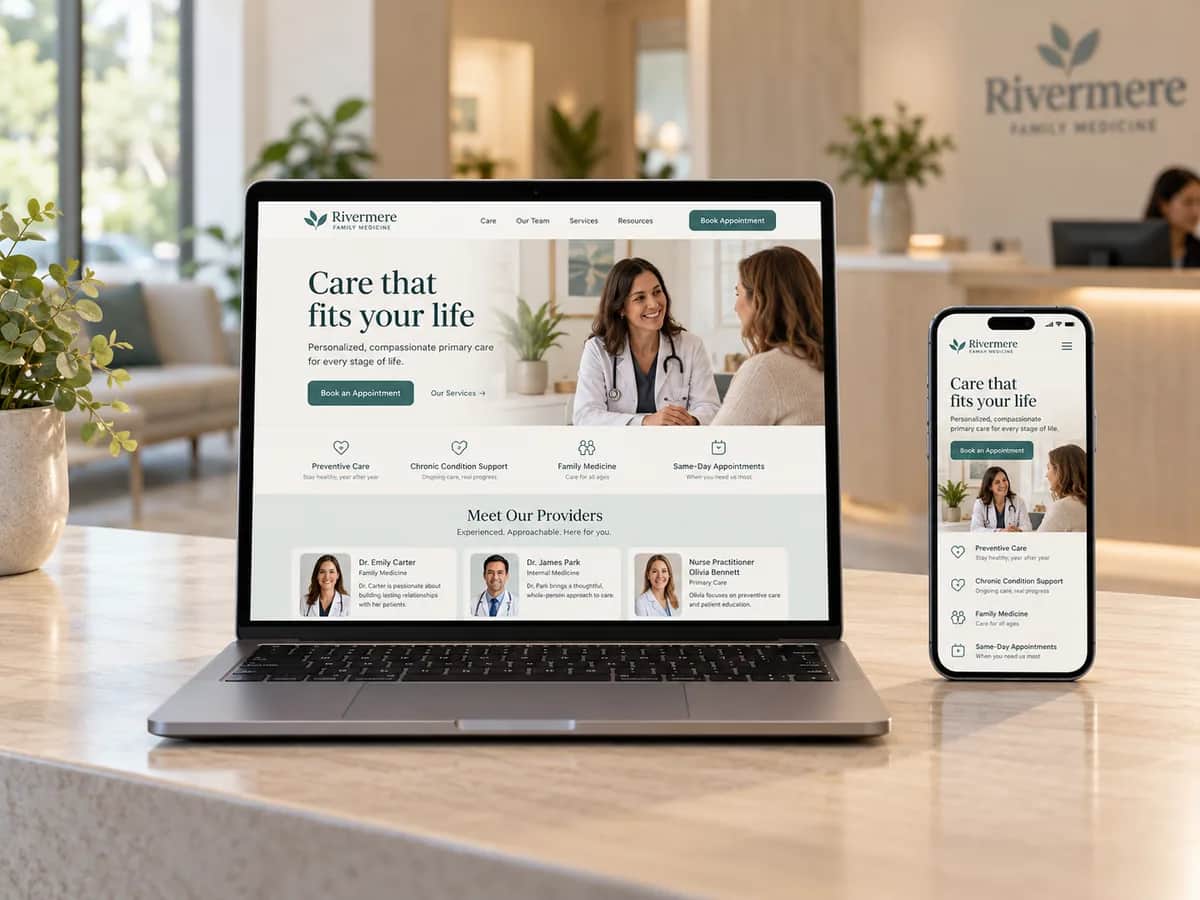
It answers patients' first questions fast: whether you're accepting new patients, which insurance you take, how to book and where the patient portal is. It also has provider bios, plain-language service pages, accessible design for patients of every age, and forms that keep health information off the marketing site.
Yes. We link to the portal and telehealth tools your EHR vendor provides and embed its scheduling where supported. We don't copy patient data into the marketing site; it stays in the systems built to protect it.
State the annual fee, what membership includes, how it works alongside insurance, and whether the panel is open or waitlisted. Prospects who understand the model before the consultation call are far more likely to enroll.
On public pages, with care: a 2024 federal court ruling narrowed HHS's tracking guidance for unauthenticated pages. Keep pixels off logged-in pages, portals and forms that collect health information, and use Google Consent Mode.
If you receive federal financial assistance from HHS, such as Medicaid payments, yes: by May 11, 2027 with 15 or more employees, or May 10, 2028 with fewer. We build every practice site to WCAG 2.1 AA either way.
Practice websites start at $2,500 and landing pages at $699. Custom patient apps start at $8,000. You receive a fixed-scope quote before we start.
Planning a new practice website?
Tell us about your practice model, EHR and scheduling tools. We'll reply with a fixed-scope quote.